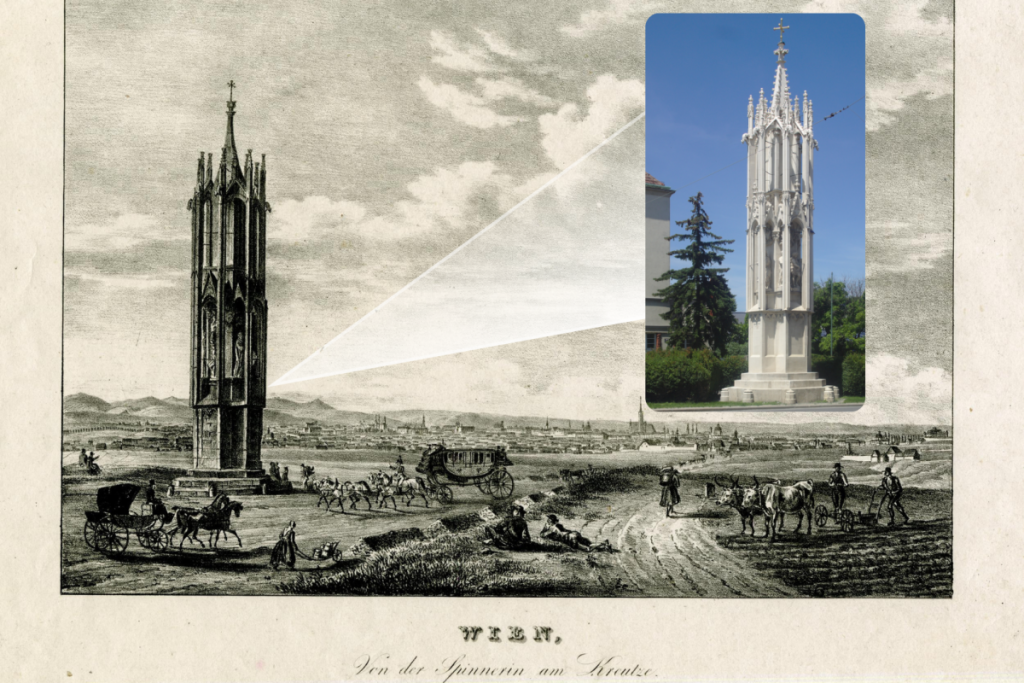

Thousands of you commute into the city via Triester Straße every workday, but have you ever looked up? Much like at Stock-im-Eisen Square, it’s easy to overlook this legendary Viennese landmark. The “Spinnerin am Kreuz” towers atop the Wienerberg in Vienna’s 10th district. This monumental Gothic tabernacle sculpture is one of the city’s most significant medieval monuments and commemorates a chapter of Vienna’s history that lies right on the border between bustling traffic and historic ground.
The “Spinnerin am Kreuz” has been extensively restored on multiple occasions following destruction and war damage—including in 1452, 1598, and in the 19th century. Severe weather conditions and modern traffic congestion also necessitated ongoing conservation work. For this reason, the delicate original statues were replaced with replicas. You can admire the originals at the Favoriten District Museum.
The Spinner at the Cross: Favoriten’s Most Famous Landmark
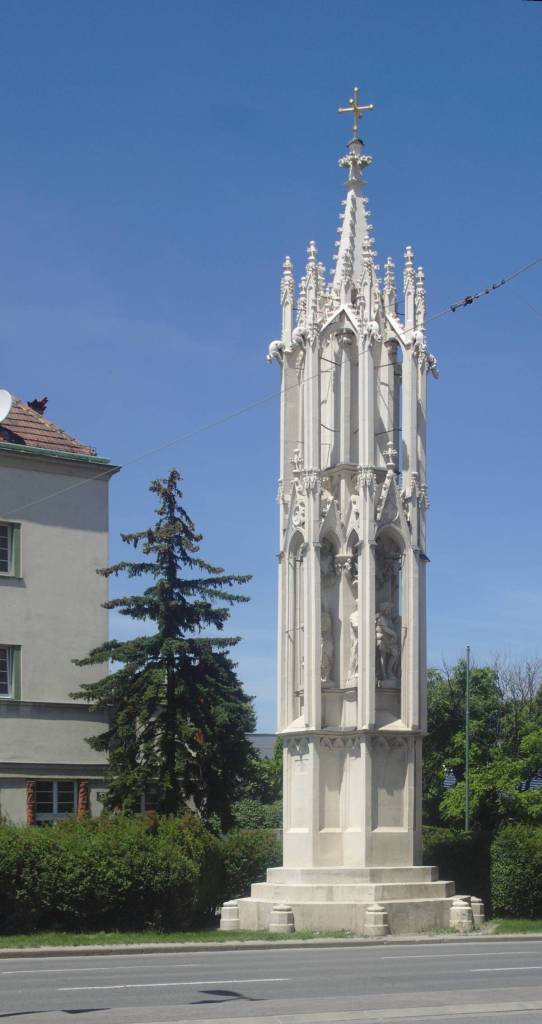
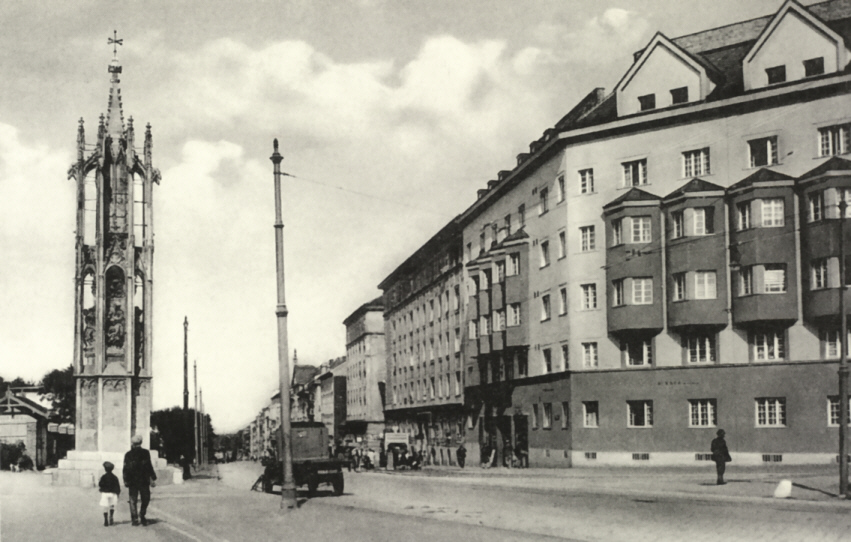
Today, the stone monument stands in the middle of Favoriten’s urban hub, surrounded by residential buildings and multi-lane roads. Originally, the hill marked Vienna’s southern city boundary and was visible from afar. Where cars now roll, there stood for centuries a striking vantage point that guided travelers and served as a memorial at the same time.
Love, longing, or pure legend?
A legend surrounds the name that almost every Viennese schoolchild knows. It is said that during the time of the Crusades, a faithful wife sat here day after day with her spindle, waiting for her husband. When he returned safe and sound, the couple donated the monument out of gratitude. Whether the story actually unfolded that way remains to be seen—but in any case, the legend has given the stone block its name to this day.
A High Gothic masterpiece and the somber Galgenberg
From an architectural-historical perspective, the matter is clearer. Master builder Hanns Puchsbaum redesigned the delicate wayside shrine in the mid-15th century after the previous structure had been destroyed. With its ornate pinnacles, gables, and reliefs, the column exemplifies the art of late Gothic stonemasonry in its purest form. However, the location also had its dark side, as the Wienerberg served as the city’s execution site for a long time.
On May 30, 1868, Austria’s last public execution took place at the Spinnerin am Kreuz on the Wienerberg. Twenty-three-year-old Georg Ratkay was hanged on the gallows for robbery and murder in front of an estimated 30,000 onlookers. The ensuing festive revelry prompted Emperor Franz Joseph to ban public executions in the future.
The best way to reach the monument via Wiener Linien is to take tram line 1 to the Stefan-Fadinger-Platz stop, followed by a short walk uphill. By car, take the B17 (Triester Straße) directly past the column; parking is available in the surrounding side streets of the residential areas.
Location: Triester Straße / corner of Windtenstraße, 1100 Vienna
Date and Time: Open to the public 24 hours a day, year-round
Cost: Free